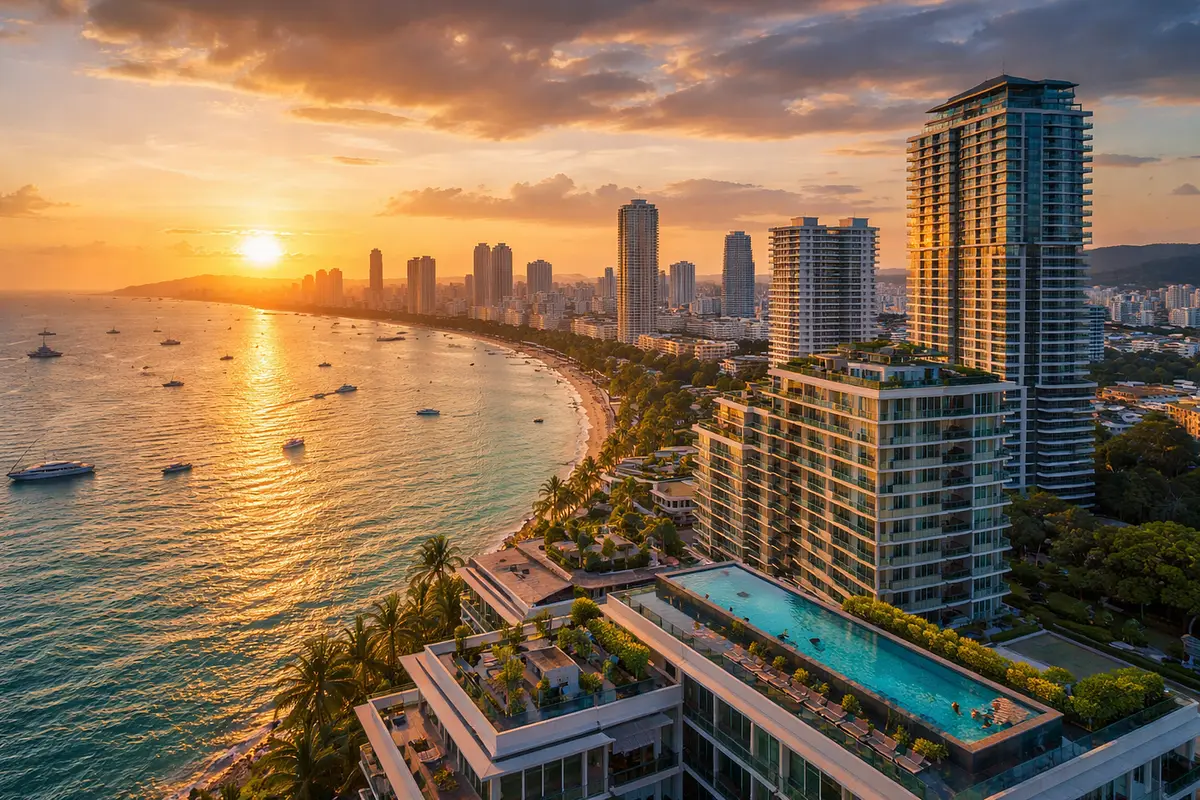
The Ultimate Guide: Buying Property in Thailand as a Foreigner (2026)
Everything you need to know before buying real estate in Thailand as a foreigner: what you can own, title deeds, the buying process, who pays which taxes, the FET form, and why Pattaya.
Foreigners have been buying property in Thailand for decades. The market is still widely misunderstood, and plenty of half-truths circulate. This guide from Pearl Property Pattaya sets out the legal basics for 2026: what you can own, which documents matter, how a safe purchase works and who pays which costs.
1. The Legal Framework: What Can Foreigners Actually Buy?
The ground rule is simple: foreigners cannot own land in Thailand in their own name. There are, however, legal and secure ways to buy property, and Pattaya offers some of the best opportunities in the country.

Option A: Condominium Freehold (the Safest Route)
Under the Condominium Act, foreigners may together own up to 49% of the total saleable floor area of a condominium building. Within that quota you own your unit outright: your name is on the unit title deed, and you can sell it and leave it to your heirs. You can rent it out on monthly or yearly leases. Stays under 30 days count as a hotel business under the Hotel Act, which a private condo unit cannot legally operate. Freehold condo ownership is the gold standard for foreign buyers.
Option B: Villas and Houses
Because the land itself cannot be in a foreigner's name, a villa or house is held through a registered right over the land. The building itself can be owned in your name.
- Sap Ing Sith (Real Right Act B.E. 2562 / 2019): a registered real right over land or buildings for up to 30 years. Because it is a right in the property itself and is entered on the title deed, it can be sold, mortgaged and inherited without the landowner's consent, and it survives a sale of the land. It is still relatively new and less tested at Land Offices than a lease, so have your lawyer structure it. Since the nominee crackdown, it is the first structure we ask lawyers about for houses and villas.
- Leasehold: a lease of up to 30 years, registered at the Land Office. The first 30-year term is registered and secure. Contracts often promise further 30-year renewals, but these renewals are a contractual promise, not a registered right. Their enforceability against a new landowner or heirs is uncertain, so plan with 30 years. A lease is also harder to transfer or use as security than Sap Ing Sith.
⚠ We no longer recommend the Thai Company Limited route, in which the foreign buyer holds 49% of the shares and Thai shareholders hold the rest. Since the crackdown on nominee shareholdings, the authorities have been actively auditing companies that exist only to hold land for a foreign owner. The consequences reach the foreign buyer, not just the Thai nominees. If you already own through such a company, have a Thai lawyer review it. See our analysis of the nominee crackdown.
Pearl Property Tip: For most buyers, a freehold condominium is the simplest, most secure and most liquid investment. For a villa with a garden and private pool, Sap Ing Sith is the structure to ask your lawyer about first.
2. Title Deeds: Why the Chanote Matters
Thailand has several types of land document. For a foreign buyer, the one to look for is the Chanote (Nor Sor 4 Jor). Condo units have their own unit title, issued per unit once the building is registered as a condominium.

What makes a Chanote the gold standard:
- Its boundaries are precisely surveyed and GPS-referenced by the Land Department.
- Official marker posts are set in the ground.
- It carries the official red Garuda seal on the front.
- The full ownership, mortgage, lease and transfer history is recorded on the back.
- It is recognised for all transactions, including mortgages and inheritance.
⚠ A Nor Sor 3 Gor can be sold and leased, but it is less precise; have it checked and, ideally, upgraded to a Chanote. Avoid Nor Sor 3, Sor Kor 1, Por Bor Tor 5 and Sor Por Kor 4-01: they give no secure basis for a foreign buyer.
3. The Secure Buying Process: Step by Step
A safe property purchase in Thailand follows a clear sequence. Skipping a step is where buyers get into trouble.
| Step | Action | Key Point |
|---|---|---|
| 1 | Reservation Agreement | Pay a reservation deposit (often THB 50,000–200,000) to take the unit off the market. Make sure the deposit is refundable if due diligence fails, and confirm the foreign quota first; see what to check before you pay a deposit. |
| 2 | Due Diligence | At the Land Office, verify ownership and check for mortgages or legal blocks. For condos, get the debt-free letter from the juristic person confirming that common fees and the sinking fund are paid. |
| 3 | Sale & Purchase Agreement (SPA) | Fix the cost split, transfer date and all conditions. Insist on an English version, and have it reviewed by an independent lawyer. |
| 4 | Land Office Transfer | For resale units the transfer typically follows within 30–60 days of signing, as agreed between the parties. Costs are paid and the transfer is registered. You receive the title deed in your name. |
After transfer, a foreign owner who lives in the property can apply at the district office for a yellow house book (Tor Ror 13). It serves as a useful proof of address, for example for a driving licence or at the bank. The blue house book (Tabien Baan Tor Ror 14) is for Thai nationals.
4. Taxes, Fees and Ongoing Costs

Several charges are due at the Land Office on transfer day. By law most of them are the seller's taxes. Who actually pays what is set by negotiation and written into the SPA. See our Thailand property tax guide for the details.
| Fee | Rate | Legally / usually paid by |
|---|---|---|
| Transfer Fee | 2% of the appraised value | Negotiable, most often split 50/50 |
| Specific Business Tax (SBT) | 3.3% of the higher of appraised value or sale price, only if the seller has owned for under 5 years | Seller |
| Stamp Duty (only if no SBT) | 0.5% of the higher value | Seller |
| Withholding Tax | Company seller: 1%. Individual seller: progressive rate on the appraised value | Seller (deducted at transfer) |
What should a buyer budget?
- Standard split (half the transfer fee, seller pays the taxes): about 1% of the price.
- Pattaya resale deals where the seller asks to split all costs 50/50: the buyer's share can reach roughly 2–3%.
- New builds: the developer pays the seller taxes. The buyer usually pays part or all of the transfer fee plus the building charges below.
Use the figure from your contract in the ROI calculation.
Ongoing Costs
- Common area fees (CAM): about THB 20–100 per sqm per month, depending on the building's standard and facilities. They cover the pool, security, gym, lifts and building upkeep, and are paid monthly, quarterly or yearly.
- Sinking fund: a one-time payment at purchase for major future repairs, typically several hundred baht per sqm.
- Electricity and water: billed by the utility or the building. The electricity rate is set per kWh by the utility; water costs are low.
- Land and Building Tax: an annual tax, very low for a residential condo (from 0.02% of the appraised value). See the full cost of owning a condo.
5. The FET Form: the One Document That Can Block Your Purchase
When buying a freehold condominium, you must prove that the purchase money came from abroad. For transfers above USD 50,000, the receiving Thai bank documents this with a Foreign Exchange Transaction (FET) form. For smaller amounts it issues a credit advice.
The three rules:
- Send foreign currency, never Thai baht: transfer the purchase price from abroad in a foreign currency (EUR, CHF, USD, GBP etc.). Money that arrives already converted into baht cannot be documented as an inbound foreign-currency conversion.
- Convert in Thailand: the conversion into baht must happen at the receiving Thai bank, not at your home bank before sending.
- State the purpose and keep the form: give the purpose as the purchase of your condo unit, naming the project and unit. Keep the FET form safe. You need it at the Land Office, and again when you sell and send the money home.
⚠ Without proper proof that the funds came from abroad, the Land Office will not register the unit under the foreign quota.
6. Why Pattaya Stands Out in 2026
Three structural factors set Pattaya apart from other Thai property markets:
A long season: Pattaya has no monsoon-driven dead season like Phuket's west coast. It combines foreign tourists, long-stay expats and Thai weekend visitors, so rental demand is spread across the year. Occupancy still varies by building and season, so no year-round rental income is guaranteed.
Eastern Economic Corridor (EEC): the government's flagship infrastructure programme for the Eastern Seaboard includes the U-Tapao airport expansion and a high-speed rail link to Bangkok's airports. These projects support long-term demand, but their timelines have slipped repeatedly. Treat them as an upside, not the basis of your calculation.
Bangkok's weekend hub: Bangkok residents buy weekend homes in Pattaya. This domestic demand sits alongside foreign demand and supports resale liquidity, especially for well-located, well-managed buildings.
Rental yields, realistically: well-located condos in Pattaya typically achieve around 5–8% gross. After common fees, furnishing, vacancy and management, that is roughly 4–6% net. Sea-view units in Jomtien and Wongamat tend to rent and resell best. See what Pattaya tenants actually want.
Conclusion: Security Through the Right Partner
Buying property in Thailand is a sound way to invest and upgrade your lifestyle, provided you play by the rules. The legal framework is clear once it is explained properly. What separates successful buyers from those who get burned is a local partner who makes the market transparent, does thorough due diligence and guides you safely through transfer.
That is what Pearl Property Pattaya does for every client, on every transaction. For independent legal review we work with Lawyers for Expats Thailand. This guide is general information, not legal advice.
Related guides
Related articles
- Can You Sell an Off-Plan Condo in Pattaya Before Completion?
- How to Check a Pattaya Condo Building Before You Buy
- How to Own and Run a Pattaya Condo From Abroad: Bills, Tenants, Repairs and Visits for Remote Owners
More in Buying Guides
Popular searches: Condos for sale in Pattaya • Houses for sale in Pattaya • Villas for sale in Pattaya • Condos for sale in Jomtien • Condos for sale on Pratumnak Hill • Pool villas for sale in Huai Yai • Pattaya neighborhoods
Published by Pearl Property Pattaya — Thai-German real estate agency in Pattaya since 2015. Advice spoken and written in English, German, Thai, French and Chinese.
Contact: info@pearlpropertypattaya.com • WhatsApp
More articles about Pattaya real estate →