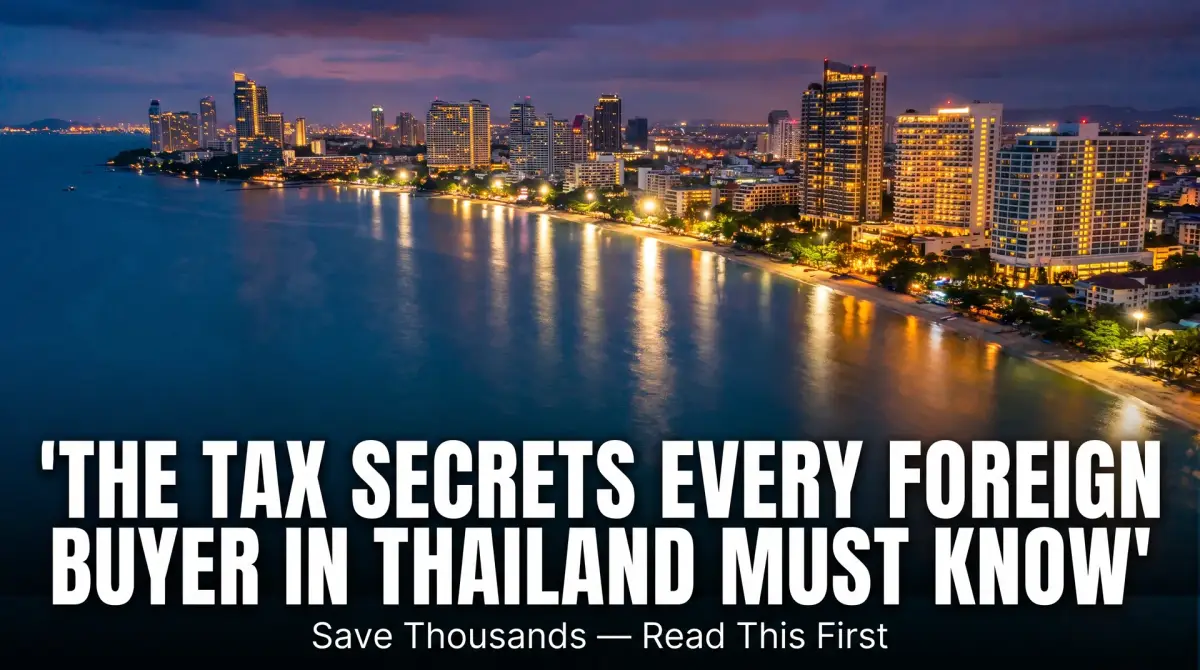
Thailand Property Tax Guide: Essential Planning for Foreign Investors
A complete guide to Thai property taxes for foreign investors — transfer fees, SBT, rental income tax, land & building tax, legal structures, and the FET form explained with real Pattaya examples.
Buying property in Pattaya is an exciting milestone. Whether you're purchasing a beachfront condo for retirement or a city-center apartment for rental income, the lifestyle and financial benefits are undeniable. However, there's one topic that most foreign buyers overlook until the very last minute: taxes and legal structures.
It's a common scenario: a buyer finds their dream condo, agrees on a price, and suddenly gets hit with unexpected transfer fees and tax bills at the Land Office. Or worse, they start generating rental income without understanding their tax obligations in Thailand, leading to headaches down the road.
In this beginner-friendly guide, we will break down the complex world of Thai property taxes and legal structures into simple, easy-to-understand terms. We'll use real-world examples from Pattaya to show you exactly what to expect, how to prepare, and how to structure your investment safely and legally.
If you are just starting your property journey, we highly recommend reading our Ultimate Guide: Buying Property in Thailand as a Foreigner (2026) first to understand the basics of foreign ownership.
The Reality of Buying Property in Thailand
Before we dive into the numbers, it's crucial to understand the foundational rule of Thai real estate: Foreigners cannot own land in their own name.
However, foreigners can own condominium units 100% freehold, provided that foreign ownership in the entire building does not exceed 49% of the total floor area (the "Foreign Quota"). Because of this straightforward and secure ownership structure, condos are by far the most popular choice for international investors in Pattaya.
If you're wondering whether you should buy a brand-new unit or an older one, check out our comparison: Brand New or Resale Condo? The Real Cost, Risk and Rewards Explained.
Now, let's look at the taxes and fees you will encounter during your property journey. We can divide these into three main phases: Buying, Owning, and Selling.
Phase 1: Taxes and Fees When Buying a Property
When you purchase a property in Thailand, the transaction must be registered at the local Land Office. This process incurs several fees and taxes. The total cost usually ranges from 1% to 6.3% of the property's value, depending on how long the seller has owned it and how the contract is negotiated.
Here are the specific charges you need to know:

1. Transfer Fee (2%)
This is the standard fee charged by the Land Office to transfer the title deed (Chanote) into your name. It is calculated at 2% of the government-appraised value of the property, which is often slightly lower than the actual market price.
- Who pays? In Pattaya, the standard practice is a 50/50 split between buyer and seller — each party pays 1%.
2. Stamp Duty (0.5%)
Stamp duty is charged at 0.5% of the registered value or the appraised value, whichever is higher. Note: If Specific Business Tax applies, Stamp Duty is waived.
- Who pays? In Pattaya, this is split 50/50 between buyer and seller as part of the standard closing arrangement.
3. Specific Business Tax (SBT) (3.3%)
This tax is designed to discourage property flipping. It is charged at 3.3% of the registered or appraised value (whichever is higher) if the seller has owned the property for less than 5 years. If the seller has owned it for more than 5 years, or if it has been their primary registered residence for over a year, this tax does not apply.
- Who pays? Again, in Pattaya the standard practice is a 50/50 split.
4. Withholding Tax (1% to 3%)
This is the income tax on the sale profit. If the seller is a company, the rate is fixed at 1%. If the seller is an individual, it is calculated based on a progressive income tax scale.
- Who pays? In Pattaya, this is also typically split 50/50 as part of the overall closing cost arrangement.
Example 1: Buying a Resale Condo in Jomtien
Let's look at a practical example. You are buying a resale condo in Jomtien for 3,000,000 THB. The seller has owned the property for 6 years (so no Specific Business Tax applies). The government appraised value is 2,800,000 THB.
| Cost Item | Total | Your Share (50%) |
|---|---|---|
| Transfer Fee (2% of ฿2.8M appraised) | ฿56,000 | ฿28,000 |
| Stamp Duty (0.5% of ฿3M) | ฿15,000 | ฿7,500 |
| Withholding Tax (~1% of ฿3M) | ฿30,000 | ฿15,000 |
| Total Closing Costs | ฿101,000 | ฿50,500 |
Your total closing costs: approximately ฿50,500 (roughly 1.7% of the purchase price).
Crucial Tip: While the 50/50 split is standard practice in Pattaya, always confirm this in writing before signing any contract. Budget approximately 1.5% to 2% of the purchase price as your share of the total closing costs — this way you will never be caught off guard.
Phase 2: Taxes When Owning and Renting Property
Once you own the property, you transition from buying costs to holding costs and income taxes.
The Land and Building Tax
Introduced recently, this is Thailand's version of an annual property tax. The good news? The rates are incredibly low compared to Western countries.
For a condominium used for residential purposes (not rented out commercially as a hotel), the tax rate is typically around 0.02% of the appraised value per year.
- Example: For a condo appraised at ฿3,000,000, your annual property tax would be just ฿600 (less than $20 USD).
This is significantly lower than the annual maintenance fees you will pay. To understand those costs, read our guide: Condo Fees in Pattaya: What You're Really Paying For.
Personal Income Tax on Rental Income
If you rent out your Pattaya condo, that income is subject to Thai Personal Income Tax, regardless of whether the money is paid into a Thai bank account or an overseas account.
As a non-resident foreigner generating income in Thailand, you are required to file an annual tax return (PND 90 or 91).
Thailand uses a progressive tax rate:
| Annual Taxable Income | Tax Rate |
|---|---|
| 0 – ฿150,000 | 0% (Exempt) |
| ฿150,001 – ฿300,000 | 5% |
| ฿300,001 – ฿500,000 | 10% |
| ฿500,001 – ฿750,000 | 15% |
| ฿750,001 – ฿1,000,000 | 20% |
| ฿1,000,001 – ฿2,000,000 | 25% |
| ฿2,000,001 – ฿5,000,000 | 30% |
| Over ฿5,000,000 | 35% |
The Standard Deduction: The Thai Revenue Department allows you to deduct a standard 30% of your gross rental income for expenses without needing to provide receipts.
Example 2: Calculating Tax on Rental Income
You own a condo in Pratumnak and rent it out for ฿20,000 per month on a long-term contract.
- Annual Gross Rental Income: ฿240,000
- Less Standard Deduction (30%): −฿72,000
- Taxable Income: ฿168,000
- First ฿150,000 → 0% = ฿0 tax
- Remaining ฿18,000 → 5% = ฿900 tax
- Your total annual income tax: just ฿900
As you can see, the tax burden on a single rental property is exceptionally low, making Pattaya a highly attractive market for investors. If you want to dive deeper into maximizing your returns, check out our Comprehensive ROI Calculation Guide.
Phase 3: Taxes When Selling Your Property
When the time comes to sell your Pattaya property, you will be the one responsible for the seller-side taxes we discussed in Phase 1.
Your primary goal should be to hold the property for at least 5 years (or put your name on the house registration book, the Tabien Baan, for at least 1 year). Doing so exempts you from the heavy 3.3% Specific Business Tax, leaving you to pay only the 0.5% Stamp Duty, your share of the Transfer Fee, and the Withholding Tax on your profit.
Legal Structures: How Should You Buy?
Now that we understand the taxes, let's address the legal structure. How exactly should you hold the asset?

1. Direct Freehold Ownership (Foreign Quota Condo)
This is the gold standard for foreign buyers. You buy a condo within the 49% foreign allocation. Your name goes directly on the Chanote (title deed) at the Land Office.
- Pros: 100% secure, easy to sell, easy to pass on to heirs.
- Cons: Limited to condominiums only; you cannot buy houses or land this way.
2. Leasehold Ownership
If a condo building has sold out its 49% foreign quota, or if you want to buy a villa/house, you can lease the property. In Thailand, the maximum registered lease term is 30 years.
- Pros: Allows you to acquire property outside the foreign quota, often at a slightly lower purchase price.
- Cons: You don't own the asset; the value diminishes as the lease term decreases; renewing the lease after 30 years requires the landowner's cooperation and is not automatically guaranteed by law.
3. Setting Up a Thai Company
Many foreigners who wish to buy landed property (villas, houses, or land) set up a Thai Limited Company to hold the asset. By law, the company must be at least 51% owned by Thai shareholders, while the foreigner owns a maximum of 49%.
- Pros: Allows you to buy land and houses; you can have voting control of the company.
- Cons: The Thai government heavily scrutinizes "nominee" companies. It involves setup costs, annual accounting fees, and corporate tax filings. It is a complex structure that requires excellent legal advice.
For 90% of our clients at Pearl Property Thailand, we strongly recommend Direct Freehold Ownership of a Condominium. It provides the best balance of security, simplicity, and investment potential.
If you are unsure which neighborhood fits your investment strategy, read our Complete Pattaya Neighbourhood Guide 2026.
The Importance of the FET Form
There is one critical legal document every foreign buyer must know about: the Foreign Exchange Transaction (FET) form.

To legally buy a freehold condo in the Foreign Quota, Thai law requires that the purchase funds originate from outside of Thailand in a foreign currency.
When you transfer money from your home country to your Thai bank account (or the developer's account), the receiving Thai bank issues an FET form. You must present this form to the Land Office to prove the money came from abroad. Without it, the Land Office will refuse to transfer the title deed into your name.
Pro Tip: Always ensure your international bank transfer clearly states the purpose as: "For the purchase of condominium unit [Number] in [Condo Name] project."
Conclusion: Planning for Success
The Thai tax system is generally very favorable to property investors, with low annual holding taxes and reasonable income tax rates. The key to a stress-free investment is simply knowing the rules before you play the game.
By budgeting for the transfer fees, keeping your property for over five years to avoid the Specific Business Tax, and sticking to the secure Foreign Quota freehold structure, you set yourself up for a profitable and safe investment in Pattaya.
At Pearl Property Thailand, we guide our clients through every step of the process — from finding the perfect high-yield condo to ensuring all contracts are secure and taxes are minimized.
Related guides
Related articles
- Can You Rent Out a Pattaya Condo on Airbnb? Rules, Building Policies and Safer Alternatives
- Why the Nominee Crackdown Is Actually Bullish for Pattaya Condos (And What Smart Buyers Are Doing Instead)
- How to Finance Your Pattaya Property: A Complete Guide for Foreign Buyers
More in Legal, Tax & Visas
Popular searches: Condos for sale in Pattaya • Houses for sale in Pattaya • Villas for sale in Pattaya • Condos for sale in Jomtien • Condos for sale on Pratumnak Hill • Pool villas for sale in Huai Yai • Pattaya neighborhoods
Published by Pearl Property Pattaya — Thai-German real estate agency in Pattaya since 2015. Advice spoken and written in English, German, Thai, French and Chinese.
Contact: info@pearlpropertypattaya.com • WhatsApp
More articles about Pattaya real estate →